Beijing Street Food Adventure
in Beijing, China
Duration
2 hours
Group Size
1–6 people
Best Time
Morning (7–9 AM when street food culture is most alive)
What You'll Experience
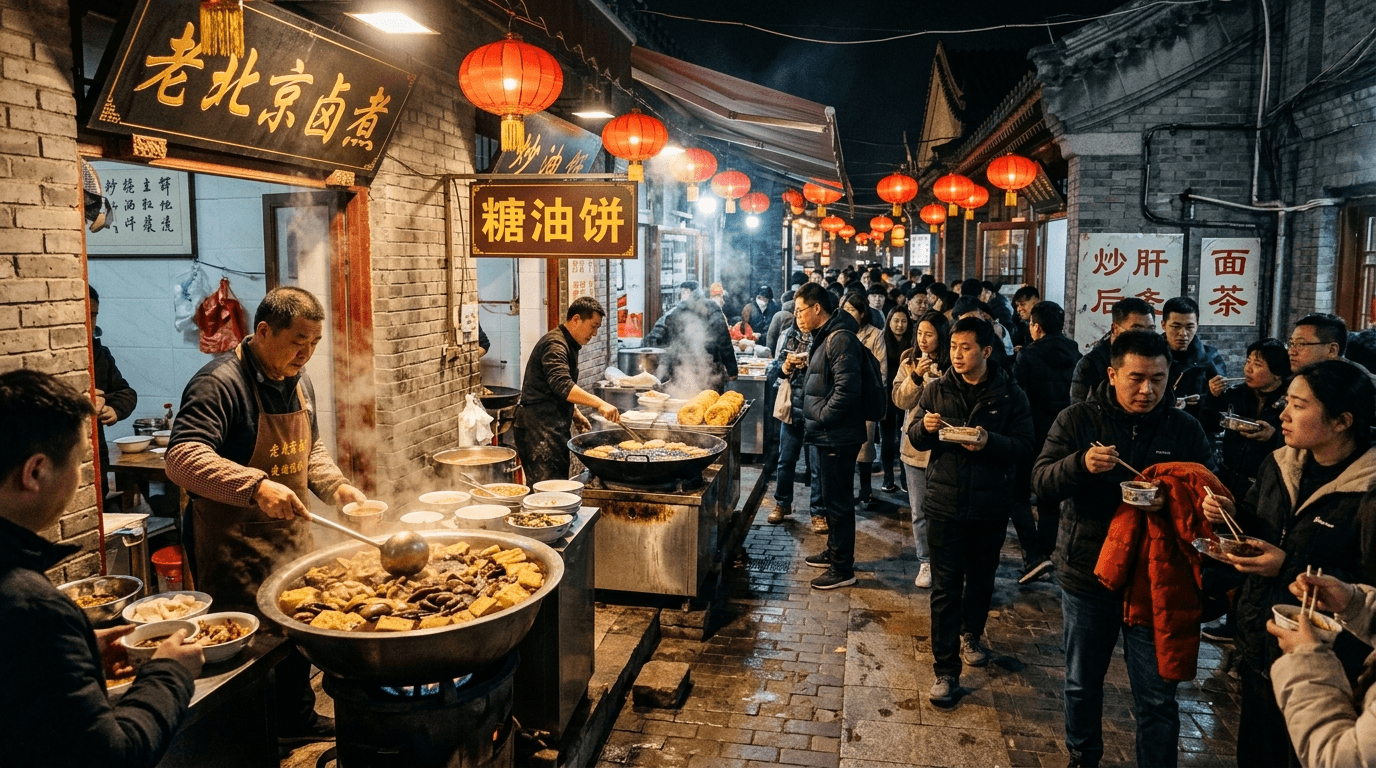
Beijing's most authentic flavors aren't in any restaurant guidebook — they're in the laneway stalls that open at 6 AM, the underground canteens that close when the food runs out, and the grandmother's cart that parks at the same corner every morning for 40 years. This walk takes you deep into working-class neighborhoods where the food has no English signage, the menus have no photos, and the price of a full breakfast is the cost of a coffee back home. You'll taste lu zhu — simmered pork offal in a rich, complex broth that locals swear cures every ailment — alongside chao gan (stir-fried liver and lung), tang you bing (caramelized dough fritters dusted in sesame), and jian bing (the layered savory crêpe that fuels half of Beijing before 9 AM). Your companion orders everything, explains everything, and makes sure you eat exactly what the locals eat — not the sanitized version they assume foreigners want.
Highlights
- Eat lu zhu (braised pork offal soup) at a stall serving the same recipe since 1979
- Watch a jian bing master build the perfect savory crêpe in 90 seconds flat
- Taste tang you bing — Beijing's beloved caramelized dough rings — hot from the fryer
- Navigate a basement canteen invisible to tourists and order like a regular
- Drink doujiang (soy milk) made the traditional way, not from a carton
What's Included
- All food and drinks tasted during the walk
- Companion to translate menus and explain each dish's history
- Printed flavor map of the neighborhood
- Transit card top-up for getting home
Meeting Point & Area
Outside Zhangzizhonglu subway station (Line 5), Exit A. Your companion will be waiting at the small plaza near the bicycle parking area.
Why Book with iGo2China
Without a companion, finding these spots is nearly impossible — they have no online presence, no English menus, and some require you to know the neighborhood shortcut to reach them. Your companion is not a guide reciting facts but a Beijinger sharing breakfast with you. No tourist traps, no overpriced food streets — the real morning ritual of 21 million people.
Why Beijing's real street food isn't on any food street
If you search 'Beijing food street' online, you'll get pictures of Wangfujing Snack Street and its scorpions on sticks. That's not Beijing food. That's a tourist set piece built specifically so visitors can take a photo and leave. Real Beijing street food happens in the hutongs at 6 AM, in basement canteens that close when the pot runs dry, and at the same corner cart that's been there for 40 years.
This walk takes you deep into working-class neighborhoods where the food has no English signage, the menus have no photos, and a full breakfast costs less than a coffee back home. Your companion orders everything, explains everything, and makes sure you eat exactly what the locals eat — not the sanitized version stalls assume foreigners want.
What you'll eat
The walk includes 6–8 dishes across 5 stops. The headline dish is lu zhu (卤煮) — simmered pork offal in a complex five-spice broth that locals swear cures every ailment. The stall we use has been making the same recipe since 1979 and the queue starts forming at 6:30 AM.
From there: jian bing (煎饼) — Beijing's beloved savory crêpe, built layer-by-layer in 90 seconds flat with egg, scallion, crispy wonton, and a smear of fermented bean paste. Tang you bing (糖油饼) — caramelized dough rings hot from the fryer, the kind that ruin every other doughnut you'll eat afterward. Chao gan (炒肝) — stir-fried liver and lung in a glossy garlic gravy, controversial even among Beijingers but unforgettable. And doujiang (豆浆) — fresh-pressed soy milk made the traditional way, served warm in a glass bowl, nothing like the cartoned version sold abroad.
What's included
The $20 per person price includes everything you eat and drink during the 2-hour walk, your companion's translation and historical context for every dish, a printed flavor map of the neighborhood you can keep, and a transit card top-up for getting home. There are no hidden costs and no tipping pressure.
Where the walk happens
We start outside Zhangzizhonglu subway station (Line 5), Exit A — your companion meets you at the small plaza near the bicycle parking. From there we cover roughly 2 km on foot through Dongcheng district hutongs, a neighborhood that has resisted gentrification longer than most of central Beijing. Several stops are in basement canteens or sub-street-level rooms invisible to anyone who doesn't already know they're there.
We deliberately avoid Wangfujing, Qianmen, and the other tourist food streets. The price-to-quality ratio there is the opposite of what we want to show you.
When to go
Mornings are non-negotiable. Beijing street food culture is a breakfast culture — most of the best stalls close by 10 AM. We start the walk at 7:00 or 7:30 AM, when the queues are forming and the food is freshest. By 9:30 AM you'll be done, fed, and dropped at a subway with the rest of the day ahead of you.
All seasons work. Winter walks come with the bonus of seeing locals huddle around steam-rising bowls of lu zhu in -5°C weather — a quintessentially Beijing scene. Summer walks are sweatier but include cold doujiang and seasonal fruit. We adjust the route slightly based on weather.
Dietary restrictions
This walk is heavily meat-based and centered on offal — lu zhu and chao gan are the cornerstones. We can offer a modified vegetarian route covering jian bing (without meat), tang you bing, doujiang, baozi (vegetable steamed buns), and seasonal pickles. Tell us when you book and we'll route accordingly. We can't accommodate halal or kosher requirements on this specific walk.
What to wear and bring
Comfortable walking shoes — we cover 2 km on uneven hutong stones. Layers in winter; the basement canteens are warm but the streets between them are cold. Bring an empty stomach and a curious palate. You don't need cash; your companion handles all transactions.
How this differs from a food tour
Food tours are scripted: same stalls, same dishes, same patter, every day. This walk is your companion sharing their actual breakfast neighborhood with you. The route adapts to which stalls have what that morning, what's freshly made, what the weather suits. You're not on a tour — you're a guest in someone's daily routine.
Frequently Asked Questions
How much does the Beijing street food walk cost?
From $20 per person for a 2-hour walk covering 6–8 dishes across 5 stops. Includes all food and drinks, your companion's translation and commentary, a printed neighborhood flavor map, and a transit top-up.
Where does the Beijing street food tour go?
Through working-class hutongs in Dongcheng district. We start at Zhangzizhonglu subway station (Line 5, Exit A) and cover about 2 km on foot. We deliberately avoid Wangfujing and Qianmen — those are tourist set pieces, not real Beijing food.
What is the best Beijing street food to try?
Lu zhu (braised pork offal soup), jian bing (savory crêpe), tang you bing (caramelized dough rings), chao gan (stir-fried liver), and fresh doujiang (soy milk). All are working-class breakfast staples with deep roots in Beijing food culture.
Is the food safe to eat?
Yes. Every stall we use has been operating for 10+ years with a loyal local clientele — the strongest food-safety signal there is. We avoid stalls with high turnover or signs of cutting corners.
Is there a vegetarian option?
Yes, with advance notice. The standard route is heavily meat-based but we can route to jian bing without meat, tang you bing, doujiang, vegetable baozi, and seasonal pickles.
Do I need to bring cash?
No. Your companion handles all transactions on WeChat Pay or Alipay. The $20 fee is paid in advance and covers everything.
More Experiences in Beijing
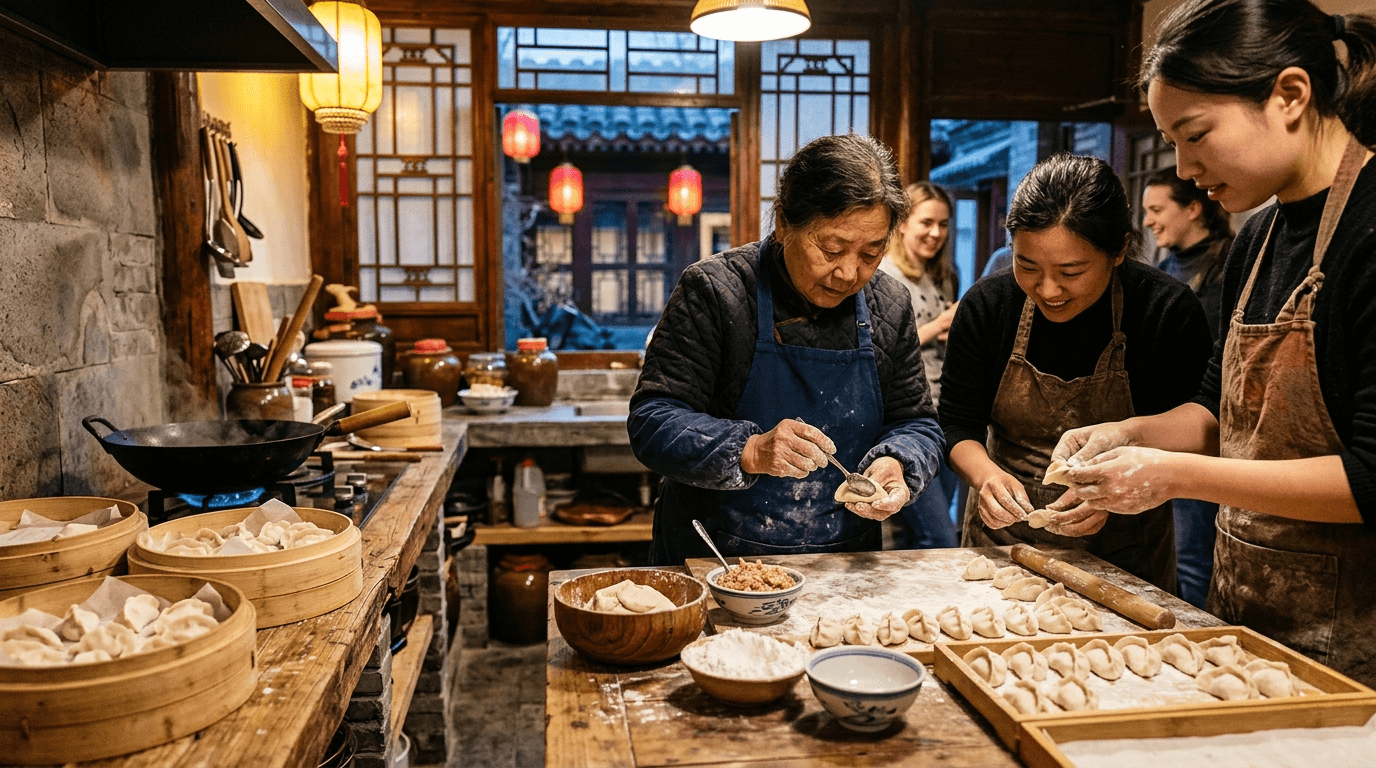
Dumpling Making Class
Learn to make 饺子 with a local family in their home kitchen — the most loved cultural experience in Beijing.
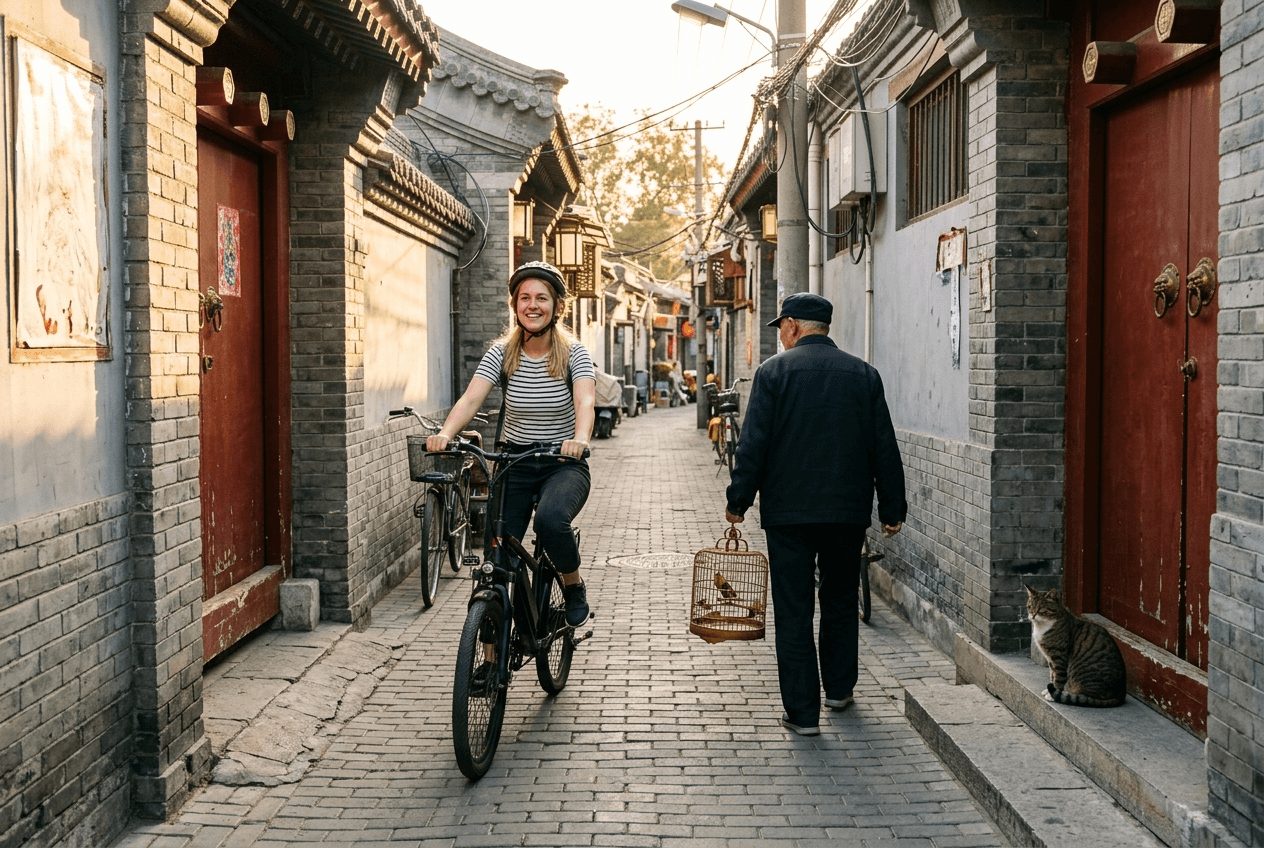
Hutong E-Bike Tour
Cruise ancient alleyways on an e-bike with your local companion — TripAdvisor's top-rated Beijing experience.

Chinese Calligraphy Workshop
Master the art of brush strokes with a patient local teacher in a traditional courtyard studio.
Before you fly: every foreign traveler needs a China Arrival Card. If you don't qualify for visa-free entry, see the COVA visa application guide.
Ready to experience Beijing Street Food Adventure?
A local companion will handle everything — you just show up and enjoy.
Book Now