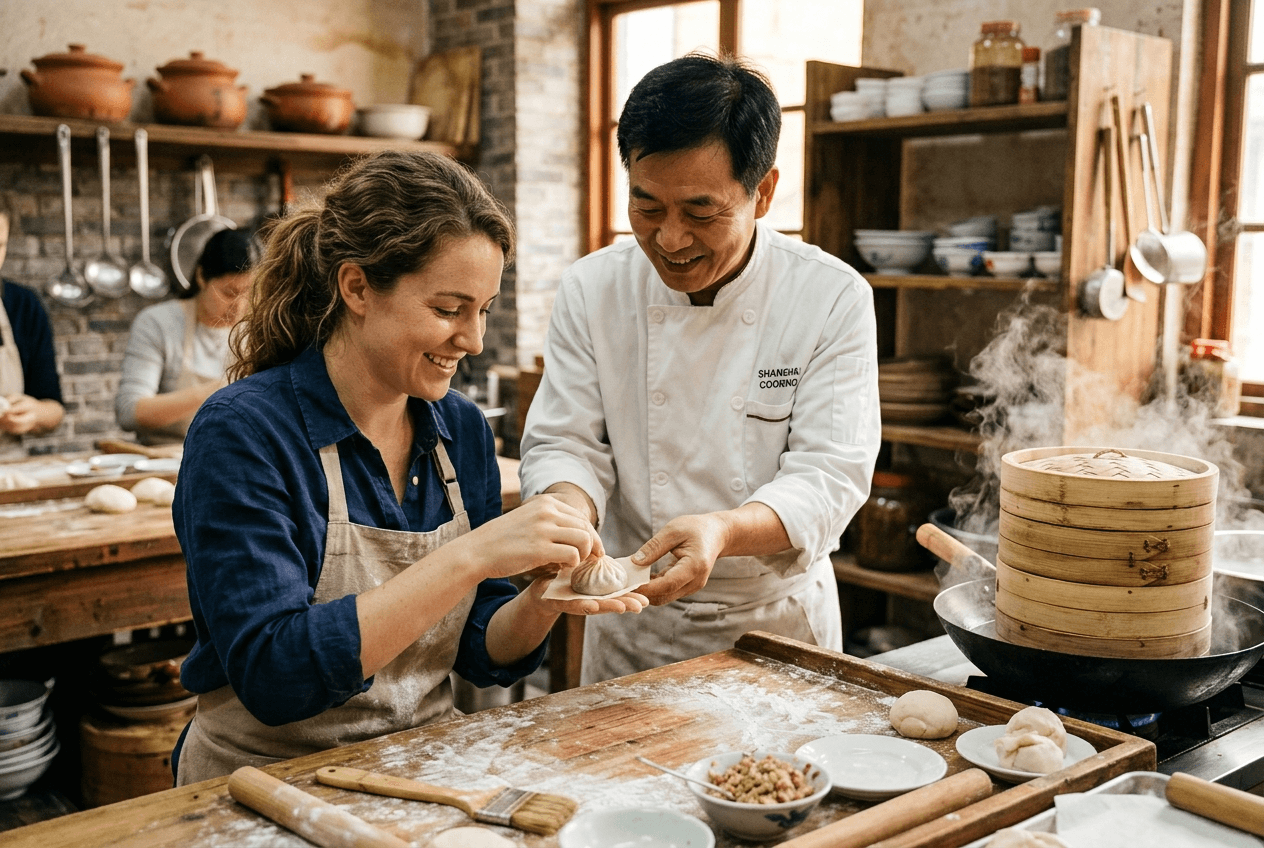
Xiaolongbao Cooking Class
in Shanghai, China
Duration
2.5–3 hours
Group Size
1–6 people
Best Time
Morning (9 AM–12 PM)
What You'll Experience
The xiaolongbao — that delicate sphere of pork and soup sealed inside the thinnest possible wrapper — is arguably Shanghai's greatest contribution to human happiness. Making one is a test of patience, precision, and the willingness to fail several times before succeeding. In a home kitchen in the French Concession, your host — a Shanghai native who learned the technique from her mother who learned it from hers — teaches you the 18-pleat seal that separates amateur dumplings from the real thing. The filling comes first: pork shoulder hand-chopped (never ground) and mixed with ginger, Shaoxing wine, and the aspic jelly that melts during steaming to create the famous soup. Then the dough: hand-rolled to translucent thinness. Then the folding: slow at first, then faster as the muscle memory develops. When the bamboo steamer opens and the fragrance hits you, you understand why people queue for these in the rain.
Highlights
- Master the 18-pleat seal — the technique that defines a proper xiaolongbao
- Make the soup-filled aspic jelly from scratch — the secret ingredient revealed
- Hand-chop (not grind) the pork filling the authentic way
- Steam your dumplings in a traditional bamboo steamer over a wok
- Eat your entire batch with black vinegar, ginger, and your host's homemade chili oil
What's Included
- All ingredients and cooking equipment
- English-speaking Shanghai local host
- Recipe card with the 18-pleat technique illustrated
- Shaoxing wine aperitif to start
- Chrysanthemum tea throughout the session
Meeting Point & Area
A residential kitchen in the French Concession (Xuhui district), a 5-minute walk from Changshu Road subway station (Lines 1/7). Exact address shared after booking.
Why Book with iGo2China
Cooking school-style xiaolongbao classes give you a pre-made filling and a laminated instruction card. This is different: a real kitchen, a real family recipe, a host who will genuinely scold you (gently) if your pleats are sloppy. Your companion bridges language and context to make the lesson personal rather than procedural.
Why a xiaolongbao class is the best food experience in Shanghai
The xiaolongbao — that delicate sphere of pork and soup sealed inside the thinnest possible wrapper — is arguably Shanghai's greatest contribution to food. Eating one is easy. Making one is a test of patience, precision, and willingness to fail several times before getting it right.
A proper xiaolongbao class in Shanghai gives you the technique that separates amateur dumplings from the real thing: hand-chopped pork (never ground), aspic jelly that melts during steaming to create the famous soup, and the 18-pleat seal that closes the top into a perfect twist. None of this is hard once you've been shown — but you have to be shown by someone who learned it from someone who learned it.
What you'll learn — the full process
Your host is a Shanghai native who learned from her mother, who learned from hers. The class runs in her home kitchen in the French Concession and covers the complete xiaolongbao process: making the pork-skin aspic the day before so it gels overnight (you'll see the prepared aspic on arrival), hand-chopping pork shoulder with a cleaver until the texture is right, mixing the filling with ginger, Shaoxing wine, soy, and sugar in proportions you'll measure by hand, rolling the wrappers to translucent thinness, and folding the 18-pleat seal — slowly at first, then faster as the muscle memory develops.
The first dumpling you fold will look terrible. The fifth will be acceptable. By the tenth, you'll have something steamable. Your batch goes into a bamboo steamer over a wok, the 8-minute timer starts, and the kitchen fills with the aroma that makes Shanghai people queue in the rain.
What's included
From $55 per person, the class includes all ingredients and equipment, your English-speaking host, a recipe card with the 18-pleat technique illustrated, the dumplings you make (you eat them — typically 12-16 per person), black vinegar and freshly grated ginger, and the host's homemade chili oil. Allow 2.5–3 hours total.
Where the class happens
In a private home kitchen in the French Concession, a 7-minute walk from Hengshan Road subway station (Line 1). The exact address is shared 24 hours before the class. The kitchen is small (max 6 students per session) which is part of the charm — there's no instructor-and-audience dynamic, just the host showing you what she's doing inches from your hands.
Best time of day
Late morning (10:00 AM–12:30 PM) sessions are ideal — you finish in time for an early lunch of your own dumplings, with leftover momentum to spend the afternoon walking the French Concession. Afternoon sessions (3:00 PM–5:30 PM) also work and end with the dumplings as an early dinner.
Dietary restrictions
We can substitute chicken for pork with 24 hours' notice (the technique is the same, the result is slightly less rich). A fully vegetarian xiaolongbao is possible — shiitake mushroom and Chinese chive filling, vegetable-stock aspic — but requires 48 hours' notice and a small surcharge for the substituted ingredients. We cannot accommodate gluten-free; the wrapper is fundamentally wheat-based.
What you'll take away
Beyond the meal, you'll leave with the recipe card, the muscle memory of the 18-pleat fold (you don't lose this — guests email us months later saying they made xiaolongbao for Lunar New Year using only the card), and the host's homemade chili oil recipe. The class is also one of the few activities in Shanghai that's genuinely good for groups of mixed ages — children from about 8 years old can fold their own dumplings and eat with the adults.
Frequently Asked Questions
How much does a xiaolongbao class in Shanghai cost?
From $55 per person for a 2.5–3 hour class. Includes ingredients, equipment, host instruction, English translation, recipe card, and the dumplings you make (12-16 per person).
How long does the xiaolongbao class take?
About 2.5 to 3 hours: aspic walkthrough, hand-chopping the pork, rolling wrappers, the 18-pleat fold, and steaming. You eat your batch at the end.
Where is the xiaolongbao class held?
In a private home kitchen in the French Concession, a 7-minute walk from Hengshan Road subway station (Line 1). Maximum 6 students per session.
Can I learn the 18-pleat technique?
Yes — it's the heart of the class. Your first dumpling will look terrible; by the tenth you'll have it. The recipe card you take home illustrates each fold.
Is the xiaolongbao class suitable for children?
Yes, from about 8 years old. Children fold their own dumplings and eat with the group. Mixed-age groups work especially well.
Are there vegetarian or chicken options?
Chicken substitution is available with 24 hours' notice. Vegetarian (shiitake and Chinese chive) requires 48 hours' notice and a small surcharge. Gluten-free is not possible — the wrapper is wheat-based.
More Experiences in Shanghai
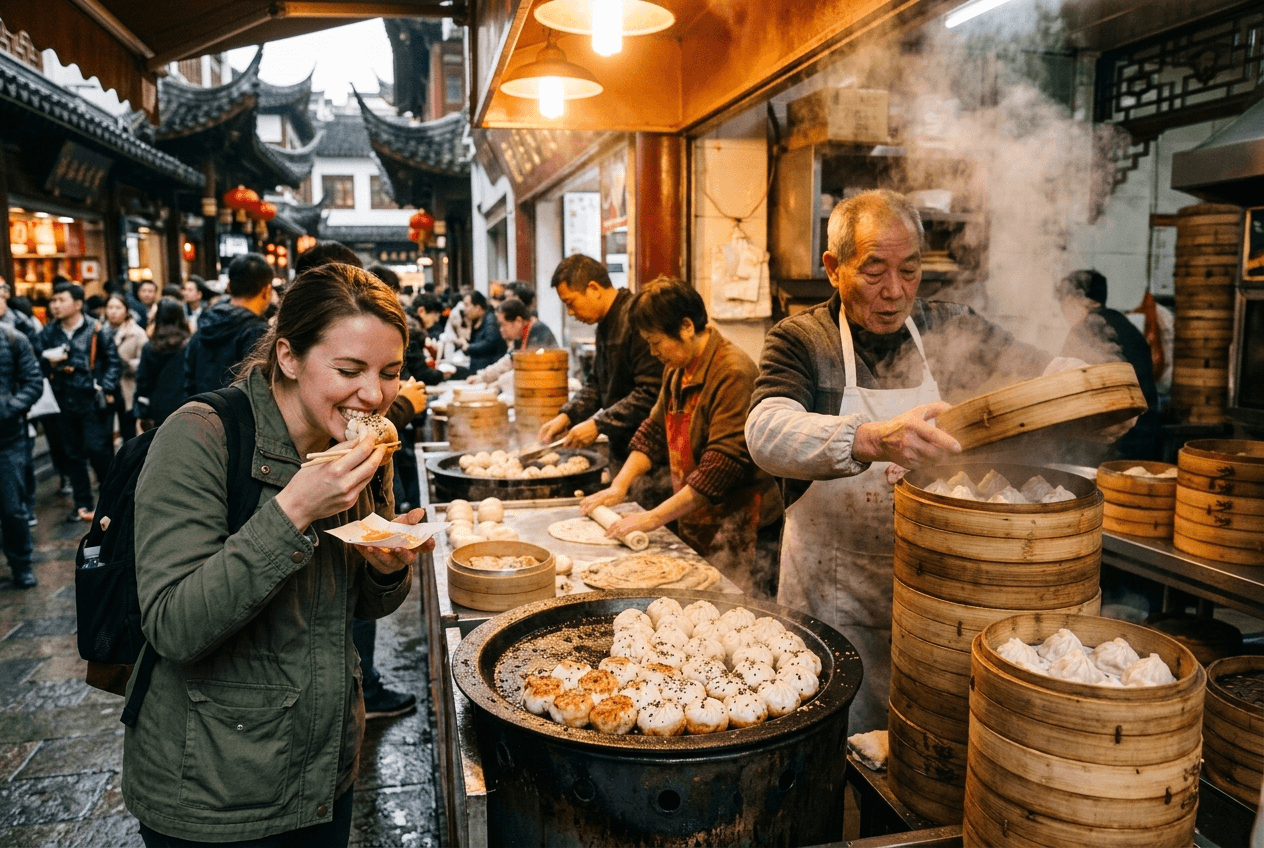
Street Food Adventure
Hunt for 生煎, scallion pancakes, 蟹壳黄, and more — the street flavors locals actually eat.
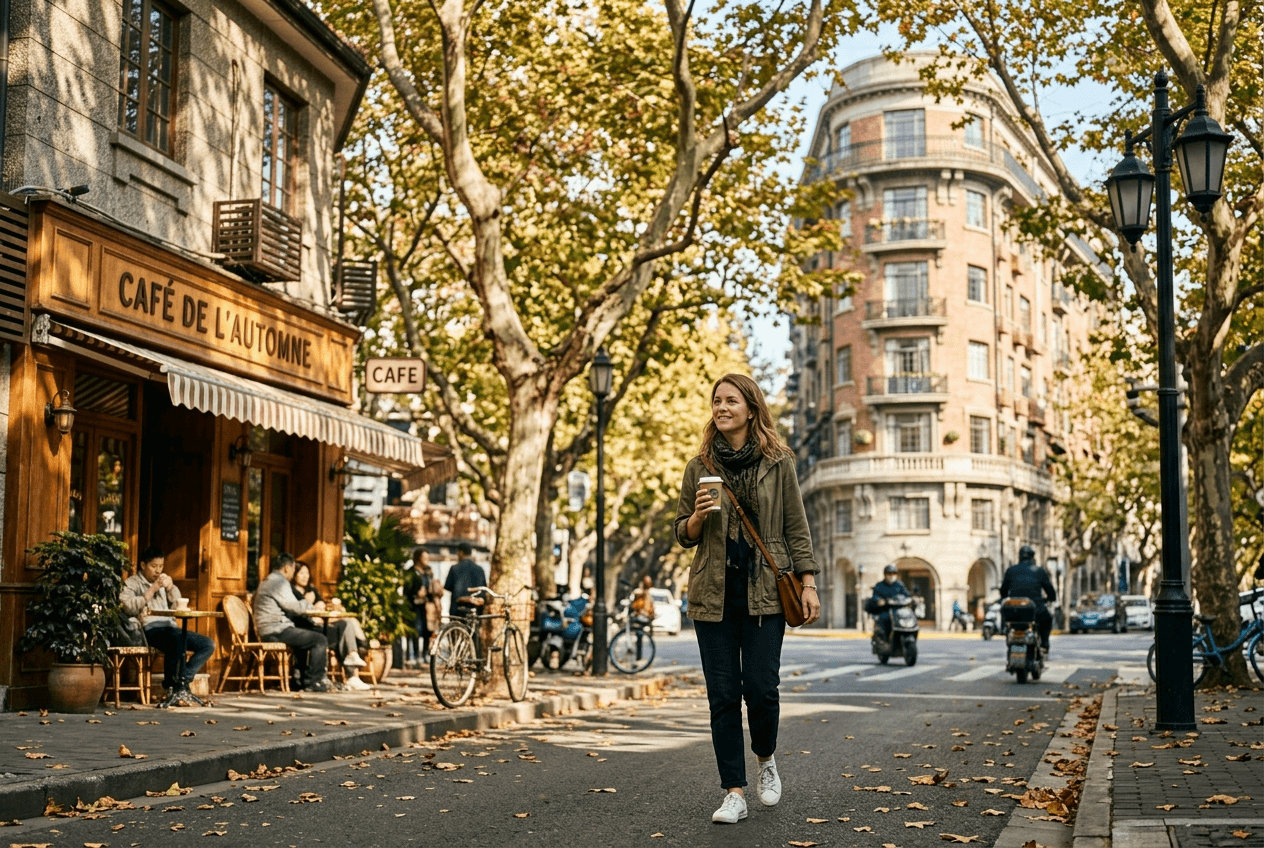
French Concession Citywalk
Stroll Wukang Road's Art Deco mansions, Anfu Road boutiques, and Yongkang Road cafés — the essence of 'Paris of the East'.
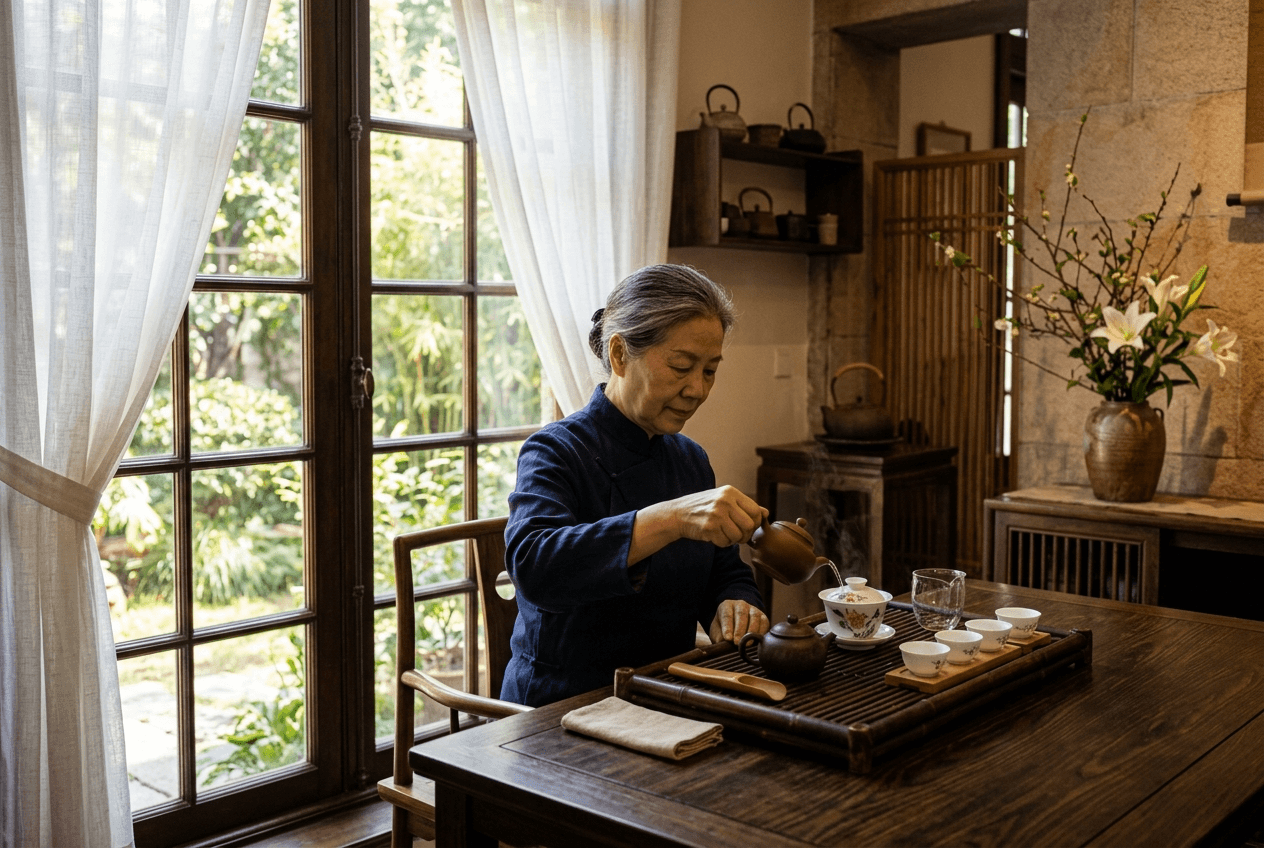
Traditional Tea Ceremony
Learn the art of Chinese tea with a seasoned tea master in a serene French Concession teahouse.
Before you fly: every foreign traveler needs a China Arrival Card. If you don't qualify for visa-free entry, see the COVA visa application guide.
Ready to experience Xiaolongbao Cooking Class?
A local companion will handle everything — you just show up and enjoy.
Book Now